What Does the Auditor's Report Say? 4 Types of Audit Opinion

Every year after the books are closed, business owners receive a set of financial statements with the “Independent Auditor’s Report” on one of the first pages. Many owners flip past it and sign, without realising that this page is the “exam result” for the whole year’s financial statements, and it is the page banks, trading partners and shareholders read first. This article shows you how to read an auditor’s report in 5 minutes: how many types of audit opinion there are, what each one means, and how to prepare so your 2026 (B.E. 2569) financial statements pass with confidence.

What is the auditor’s report and where do you find it?
A Certified Public Accountant (CPA) independently audits a company’s financial statements and gives an opinion on whether they can be relied on. That opinion is set out in the Independent Auditor’s Report, which usually appears near the front, before the statement of financial position.
Under Thai Standard on Auditing (TSA) 700 (Revised), issued by the Federation of Accounting Professions, the report contains these main sections:
- Opinion — the most important part: the result of the audit
- Basis for Opinion — explains why the auditor reached that opinion
- Responsibilities of Management for the Financial Statements — management is responsible for preparing the statements
- Auditor’s Responsibilities for the Audit of the Financial Statements — describes the scope of the auditor’s work
Tip: always read the “Opinion” section first. If its heading has changed to something like “Qualified Opinion” or “Disclaimer of Opinion”, there is an issue explained in the “Basis for” section that follows.
Two terms to know first
- Material — an error that is “big enough” to change the decisions of people who read the financial statements, for example sales overstated by so much that a bank might view a loan differently. Small errors that would not affect decisions are not material.
- Pervasive — an effect that is not limited to a single account or item but affects the financial statements broadly, or, if limited to certain items, those items make up a very large part of the statements.
These two terms decide which type of opinion the auditor gives.
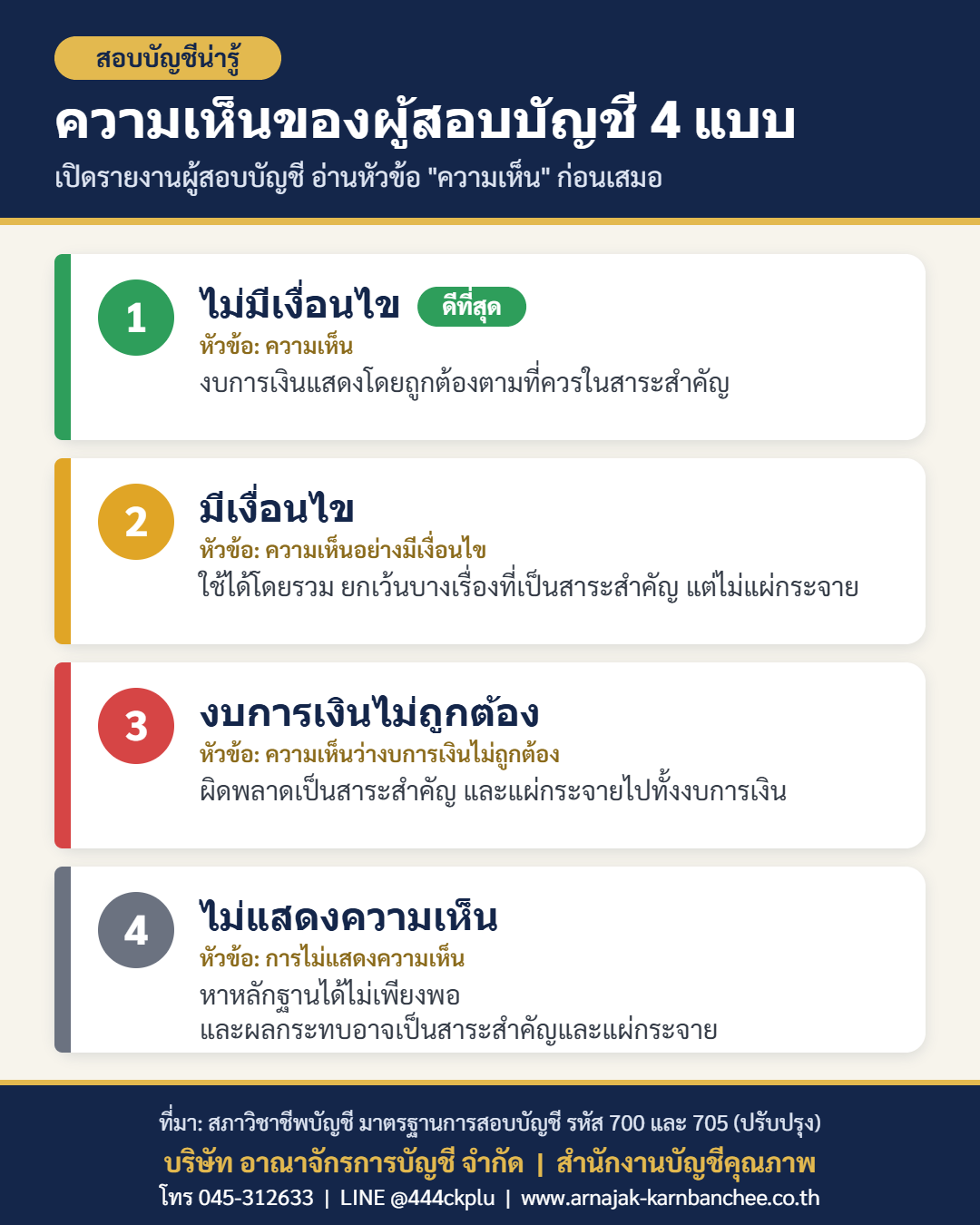
The 4 types of audit opinion
| Type | Section heading in the report | What it means in plain terms |
|---|---|---|
| 1. Unmodified (the best) |
Opinion | The financial statements are presented fairly, in all material respects. Minor errors may exist but none large enough to affect decisions. |
| 2. Qualified | Qualified Opinion | The statements are fine overall except for certain matters that are misstated or could not be verified. These are material but not pervasive. |
| 3. Adverse | Adverse Opinion | The auditor has sufficient evidence that the statements are materially misstated and the misstatements are pervasive. |
| 4. Disclaimer | Disclaimer of Opinion | The auditor could not obtain sufficient appropriate evidence, and the possible effects are material and pervasive, so no opinion can be formed. |
TSA 705 (Revised) groups types 2 to 4 together as “modified opinions”. In short:
- Misstatement or missing evidence that is material but not pervasive → Qualified
- Misstatement that is material and pervasive → Adverse
- Missing evidence that is material and possibly pervasive → Disclaimer
A simple example: a wholesaler with THB 2 million of stock
Suppose a wholesale shop has total assets of THB 10,000,000, of which THB 2,000,000 is inventory (20% of assets).
- Case A: The year-end stock count is observed by the auditor and all purchase and sales documents are complete → likely an unmodified opinion.
- Case B: No year-end stock count was done and there is no other way to verify the THB 2,000,000, but everything else is well documented → the problem is limited to inventory, so the opinion may be qualified.
- Case C: Documents for revenue, expenses and cash are missing for most of the year → almost every line is affected, so the auditor may issue a disclaimer of opinion.
Note: this example only illustrates the principle. The actual opinion depends on each business’s facts and the auditor’s professional judgement.
Why business owners should care
- Banks often ask for audited financial statements for loan applications and read the auditor’s report first.
- Trading partners and major customers may use the financial statements to assess your credibility.
- Shareholders and investors use it to judge how reliable management’s figures are.
A modified opinion usually means extra time spent explaining, so it is best to fix the root causes during the year.
One more thing to know: going concern
Going concern is the assumption that the business will keep operating in the foreseeable future. The auditor must conclude whether a “material uncertainty” exists about this, for example when a business has made continuing losses and its liabilities exceed its assets. If so, the auditor must draw readers’ attention to the related disclosures in the financial statements, and if those disclosures are inadequate, the opinion will be modified.
6-point checklist for an unmodified opinion on your 2026 statements
- Keep complete documents for every transaction: tax invoices, receipts, contracts and proof of payment.
- Reconcile bank accounts every month so your books match your bank statements.
- Count inventory at year end (31 December 2026 for a calendar-year business) and book the auditor in advance to observe the count.
- Separate personal and business money; transactions between directors and the company should be clearly documented.
- Send documents to your accounting firm on time and answer the auditor’s questions fully.
- Read the draft statements and draft report before signing. If anything is unclear, ask your auditor or accountant first.
Want financial statements people can trust? Talk to us

Arnajak Karnbanchee Co., Ltd. is certified as a Quality Accounting Firm by the Department of Business Development. We provide full-service bookkeeping, financial statement closing, tax filing and audits by Certified Public Accountants (CPA), helping you prepare documents and accounting systems for the audit from the start of the year. We serve businesses, non-profit organisations and individuals, with flexible fees to suit your needs.
Tel 045-312633, 086-8842844 | LINE @444ckplu | Email account@arnajak-group.com | Office hours Mon–Fri 8.00–17.30 | Website www.arnajak-karnbanchee.co.th
References
- Federation of Accounting Professions – TSA 700 (Revised) Forming an Opinion and Reporting on Financial Statements (Thai)
- Federation of Accounting Professions – TSA 705 (Revised) Modifications to the Opinion in the Independent Auditor’s Report (Thai)
- Federation of Accounting Professions – Thai Standards on Auditing 2024 (B.E. 2567) (Thai)