Director Loans: Separate Personal and Company Money Before Closing the 2026 Books

As the year draws to a close, many companies are getting ready to close their 2026 (B.E. 2569) financial statements, and accountants often ask the same question: “Does the director loan balance in the books match reality?” For SME owners who have mixed company money and personal money all year, this balance is often unusually high or low without them noticing. This article explains in plain language what this account is, why the money must be clearly separated, the tax effects to know, and a checklist you can act on right away before 31 December 2026.

What Is a Director Loan?
A company or partnership is a “juristic person”, meaning it has a legal identity separate from its owners. Money in the company’s bank account is therefore not the director’s personal money, even if the director is the sole owner. When money moves between a director and the company, the accountant records it in one of two ways:
| Account | Arises when | Shown in the financial statements as |
|---|---|---|
| Loan from director | The director pays company costs with personal money, or transfers money into the company | A liability (the company owes the director) |
| Loan to director | The director withdraws company money for personal use, or uses the company card/account for personal expenses | An asset (the director owes the company) |
Neither account is wrong in itself, but each needs supporting evidence and a clear reason, and the balance should be explainable. A large balance without documents usually leads to more questions from the auditor and the Revenue Department.
Why Director Balances Grow Without You Noticing
- Using one bank account for both household and business matters
- Withdrawing company cash without a withdrawal slip or receipt
- Paying personal costs, such as school fees or holidays, with the company card
- Paying suppliers on the company’s behalf with personal money but not passing the evidence to the accounting team
- Adjusting the cash balance to match actual cash by booking the difference to “director loan” and never reviewing it again
Tax Effects Business Owners Should Know
- Personal expenses are not deductible company expenses. Section 65 ter (3) of the Revenue Code treats expenses of a personal nature as “non-deductible expenses”, so they cannot reduce taxable profit, and Section 65 ter (13) disallows expenses not incurred for profit or for the business.
- An interest-free loan from the company to a director may be assessed for interest. Section 65 bis (4) allows the assessment officer to assess interest at the “market price” when the company lends money without interest, or below market rate without reasonable cause. The assessed interest becomes taxable company income.
- Interest received on loans may be subject to Specific Business Tax. Under Revenue Department rulings, interest a company earns from lending is treated as a business similar to commercial banking under Section 91/2 (5), and is subject to Specific Business Tax at 3.3% of the interest, including local tax.
- Interest paid by the company to a director requires 15% withholding tax. If the director lends to the company with interest, the company must withhold 15% of the interest under Section 50 (2) (b) and remit it to the Revenue Department.
- A loan agreement requires stamp duty of 1 baht for every 2,000 baht of the loan or fraction thereof, capped at 10,000 baht.
Simple Numerical Examples
Case A: The company lends 500,000 baht to a director
- With a written loan agreement, stamp duty = 500,000 divided by 2,000 = 250 baht
- Assume an agreed interest rate of 5% per year (for illustration only): annual interest income = 500,000 × 5% = 25,000 baht, which must be included in company income
- Specific Business Tax including local tax = 25,000 × 3.3% = 825 baht
- If no interest is charged without reasonable cause, the officer may assess interest at market price under Section 65 bis (4)
Case B: A director lends 1,000,000 baht to the company
- Stamp duty on the agreement = 1,000,000 divided by 2,000 = 500 baht
- Assume 3% interest per year = 30,000 baht. The company withholds 15% = 4,500 baht, and the director receives a net 25,500 baht
- A director may lend to the company interest-free, but there should be a clear agreement and evidence of the transfer
7-Point Checklist Before Closing the Books on 31 December 2026
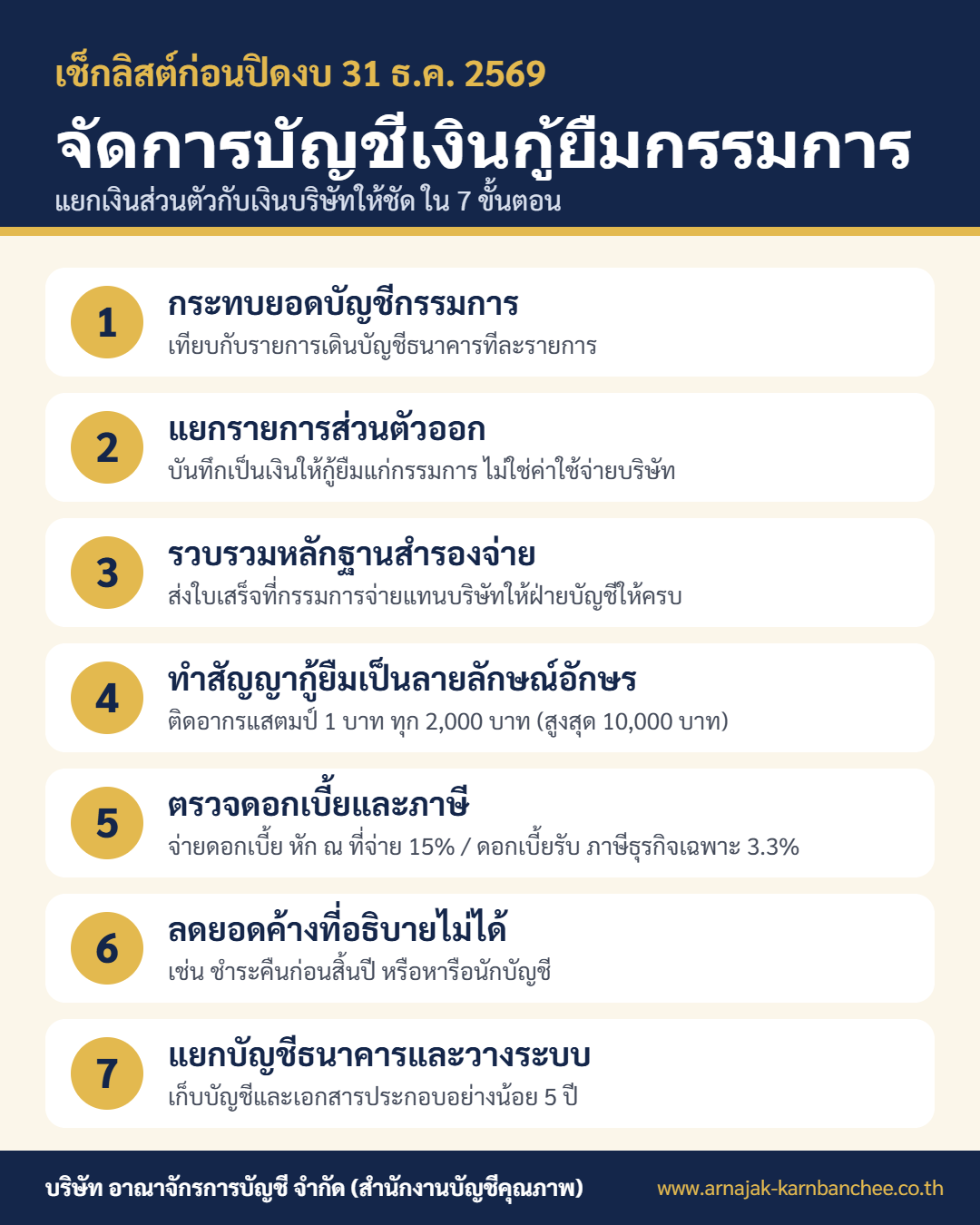
- Reconcile. Ask your accountant for the movements in the director accounts and compare them line by line with the bank statements.
- Separate personal items. Record personal expenses as a loan to the director, not as company expenses.
- Collect evidence of payments made on the company’s behalf. Hand all receipts paid by the director to the accounting team.
- Put loans in writing. State the amount, interest rate and repayment schedule, and affix stamp duty.
- Check interest and taxes. Set a reasonable interest rate, withhold tax when paying interest, and consider Specific Business Tax on interest received.
- Reduce unexplained balances, for example by repaying before year end, or ask your accountant about the correct treatment.
- Separate bank accounts and set up a system. Use company accounts and cards for business only, and keep accounts and supporting documents for at least 5 years under Section 14 of the Accounting Act B.E. 2543 (2000).
Build a Long-Term System Instead of Fixing It Every Year End
- Set clear director remuneration, such as a salary through payroll, instead of withdrawing company money at will
- Set a petty cash limit and use a withdrawal slip every time, with receipts attached
- Have your accountant summarize director balances monthly so problems are spotted early and fixed easily
- Give complete and accurate documents to your bookkeeper, as required by Section 12 of the Accounting Act B.E. 2543 (2000)
Let Arnajak Accounting Look After Your Director Accounts

If you are not sure whether your company’s director loan balance is correct, or you want a proper system to separate personal and company money before closing the 2026 books, Arnajak Accounting Co., Ltd. (a Quality Accounting Firm certified by the Department of Business Development) can help with full-service bookkeeping, financial statement closing, tax filing, audits by CPAs, and tax advisory and planning, for businesses, non-profit organizations and individuals, with flexible fees to suit your needs.
Tel. 045-312633, 086-8842844 | LINE @444ckplu | Email account@arnajak-group.com | Office hours Mon–Fri 8.00–17.30 | Website www.arnajak-karnbanchee.co.th
References
- Revenue Department: Net profit conditions under Section 65 ter (non-deductible expenses) (Thai)
- Revenue Department: Net profit conditions under Section 65 bis (Thai)
- Revenue Department: Ruling 0811/16976 on Specific Business Tax on loan interest (Thai)
- Revenue Department: Ruling 0702/1441 on withholding tax on interest paid to a director (Thai)
- Revenue Department: Stamp duty rate table (Instrument 5, loans) (Thai)
- Department of Business Development: Accounting Act B.E. 2543 (2000) (Thai)