Withholding Tax at 1% and Double Deductions: Digital Tax Benefits Thai SMEs Should Know Before the End of 2026
The end of 2026 (B.E. 2569) is close. Beyond closing the books and personal tax deductions, there are digital tax benefits many business owners have not used yet. Several related laws came out in October 2026, including withholding tax of only 1% on payments made through e-Withholding Tax and a double deduction for certain expenses. This article explains what each benefit is, who can use it, and what to prepare before the year ends.

Benefit 1: Withholding tax of 1% through e-Withholding Tax
Withholding tax is tax the payer deducts and remits to the Revenue Department on the recipient’s behalf. e-Withholding Tax (e-WHT) means deducting and remitting that tax through a participating bank at the same time as the transfer to the recipient.
Under the extended measure, payments made through e-WHT are subject to 1% instead of the usual 5%, 3% or 2%, from 1 January 2026 to 31 December 2027 (B.E. 2569–2570).
A number example: paying a THB 100,000 service fee
| Item | Usual method (3%) | Through e-WHT (1%) |
|---|---|---|
| Service fee before VAT | THB 100,000 | THB 100,000 |
| Tax withheld | THB 3,000 | THB 1,000 |
| Cash received now (excluding VAT) | THB 97,000 | THB 99,000 |
The recipient gets THB 2,000 more cash up front. However, this is not a real tax cut for the recipient. Withholding tax is a prepayment that is credited when the annual return is filed, so the main benefit is better cash flow.
For the payer, transactions made through this system do not need a withholding tax return or a withholding tax certificate. Payments made the usual way still follow the normal process.
Benefit 2: Double deduction for electronic tax systems
Companies and juristic partnerships that invest in or pay service fees for e-Tax Invoice & e-Receipt or e-Withholding Tax systems can deduct twice the amount actually paid, from 1 January 2026 to 31 December 2027.
Example: A company pays THB 60,000 for an e-Tax service and can deduct another THB 60,000. If that profit is taxed at 15%, the extra saving is about 60,000 × 15% = THB 9,000.
Benefit 3: Software and digital equipment, up to THB 300,000 extra
This measure helps SMEs adopt technology. It gives an additional exemption of 100% of the amount actually paid (often called a double deduction), but the extra part is capped at THB 300,000 per accounting period, for expenses from 24 June 2025 to 31 December 2027.
Who qualifies: Companies and juristic partnerships with paid-up capital of no more than THB 5 million and revenue from sales and services of no more than THB 30 million for the accounting period.
Key conditions:
- It must be software, hardware, a smart device or a digital service used to manage the business, and created or developed in Thailand.
- The seller or provider must be registered on the digital service list of the Digital Economy Promotion Agency (depa) before you buy.
- It must be new and ready for use by the end of the accounting period in which you pay.
- Annual maintenance fees and costs not directly related to use are excluded.
- You must prepare a report with the details and keep it at your place of business for inspection.
Example: Buying qualifying software for THB 200,000 gives a THB 200,000 extra deduction. At a 15% tax rate, that saves another THB 30,000. If you spend THB 500,000, the extra deduction stops at THB 300,000, which saves THB 45,000.
The 15% rate applies to the part of SME net profit above THB 300,000 and up to THB 3,000,000. If net profit is THB 300,000 or less, which is already exempt, this benefit may not reduce your tax further.
Checklist before the end of 2026
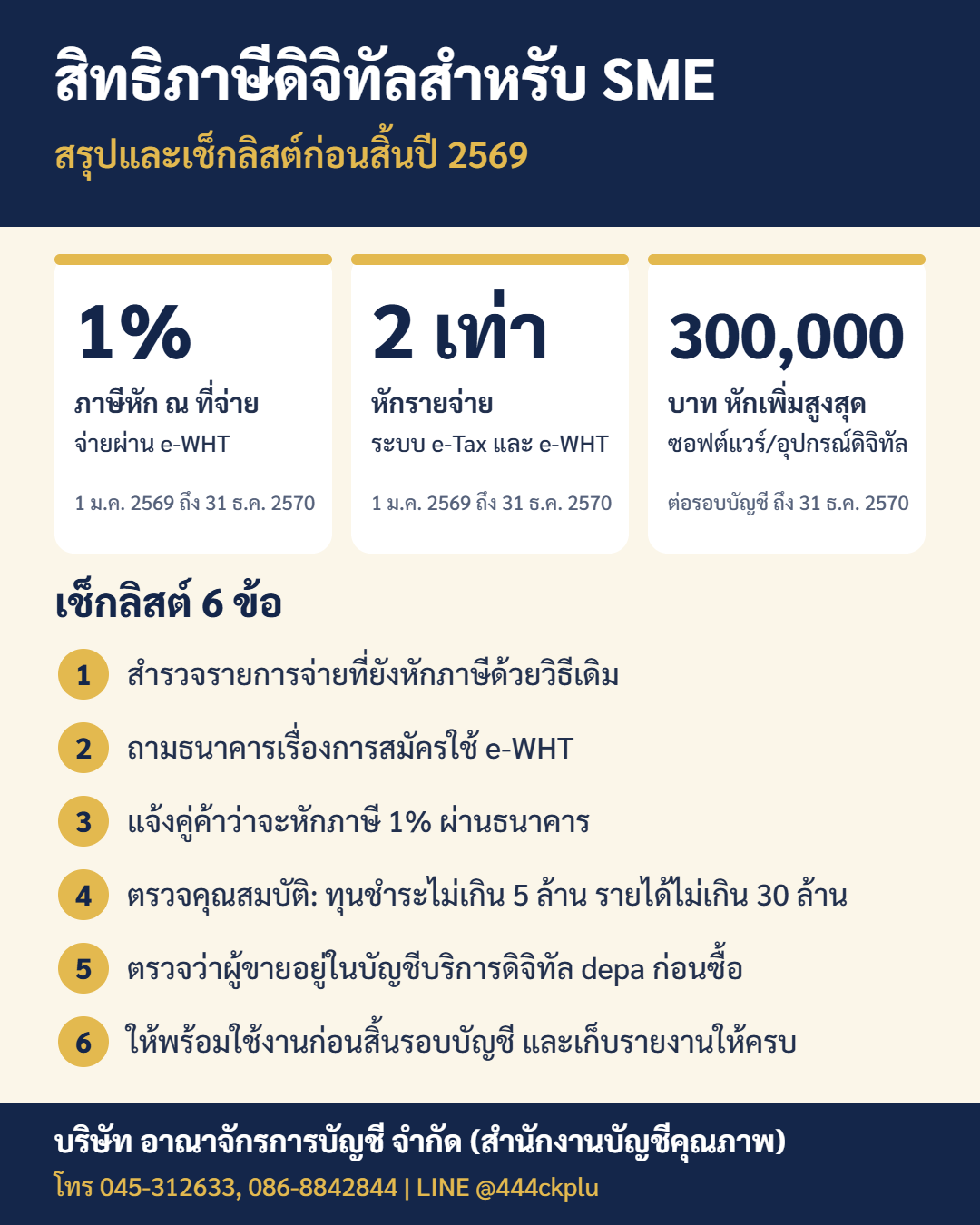
- Review your payments: List regular service, rent and advertising payments that still use the usual withholding method.
- Talk to your bank: Ask whether it offers e-WHT and how to apply.
- Tell your suppliers: Let recipients know that 1% will be withheld through the bank and that they can check the record with the Revenue Department.
- Check SME eligibility: Review paid-up capital and revenue for this accounting period.
- Check the seller first: Confirm that the product or service is on the digital service list and keep the evidence.
- Be ready in time: If your accounting period ends on 31 December 2026, buy, pay and install before that date.
- Record and report: Keep tax invoices, contracts, the start-of-use date and the benefit report together.
For individuals: Solar Rooftop also has a tax benefit
Individuals who install a rooftop solar system receive an exemption for the actual amount paid, up to THB 200,000, for purchases and installation from 3 March 2026 to 31 December 2028. It applies to one system, once, with total capacity of no more than 10 kW, for residential electricity users. You need an electronic tax invoice from a seller on the list announced by the Director-General of the Revenue Department and must notify the electricity authority that you intend to use the right. The benefit is claimed in the tax year the system is successfully connected.
Example: For a THB 150,000 installation, someone whose income falls in the 10% tax bracket saves about THB 15,000.
Ask an accountant before you decide
Each benefit has different conditions and evidence requirements. Incomplete documents can mean losing the benefit or paying a surcharge later, so it is worth checking with an accountant before you invest.

If you would like help checking which digital tax benefits fit your business, or planning your taxes before year-end, please contact Arnajak Karnbanchee Co., Ltd. (Quality Accounting Office).
Tel 045-312633, 086-8842844 | LINE @444ckplu | Email account@arnajak-group.com | Office hours Monday–Friday 8.00–17.30 | Website www.arnajak-karnbanchee.co.th
References
- Revenue Department: Press release 14/2569 on electronic tax measures (Thai)
- Ministerial Regulation No. 402 (Thai)
- Royal Decree on Tax Exemption No. 808 (Thai)
- Director-General Notification on Income Tax No. 469 (Thai)
- Revenue Department: Press release 27/2568 on digital technology for SMEs (Thai)
- Director-General Notification on Income Tax No. 470, Solar Rooftop (Thai)
- Revenue Department: Guide for SME operators (Thai)
- Revenue Department: Tax rates and calculation (Thai)