Individual or Limited Company? Tax Comparison and Checklist Before 2027

The end of the year is when many business owners ask themselves: “Should I keep running my business as an individual next year, or is it time to register a company?” The answer is not only about tax. It also depends on accounting duties, credibility and your growth plans. This article explains the differences in plain language, with simple numbers and a checklist, to help you decide before 2027 (B.E. 2570) begins.

Individual vs. juristic person: what is the difference?
Individual (sole proprietor) means you run the business under your own name. Business income is your personal income, taxed at progressive personal income tax rates (the higher your net income, the higher the rate on each next bracket). Because you and the business are the same person, business debts are also your personal debts.
Juristic person, such as a limited company, is a “legal person” separate from its owners. A limited company can be formed by two or more persons. It pays corporate income tax on net profit, and shareholders’ liability is limited to the amount payable on their shares.
| Topic | Individual | Limited company |
|---|---|---|
| Income tax | Progressive rates of up to 35% on net income | Qualifying SMEs: first THB 300,000 of profit exempt, 15% up to THB 3 million, 20% above THB 3 million |
| Regular tax returns | P.N.D. 94 (half-year) and P.N.D. 90 (annual) | P.N.D. 51 (half-year) and P.N.D. 50 (annual) with financial statements |
| Accounting | Daily cash receipts and payments report, with supporting evidence | Bookkeeping from the registration date, a qualified bookkeeper, and financial statements audited by a Certified Public Accountant (CPA) |
| Liability for debts | Business debts are the owner’s debts | Shareholders liable only up to the amount payable on their shares |
A simple example: same profit, different tax
Assume an individual’s net income (after expenses and allowances) equals the net profit of a qualifying SME company (paid-up capital not over THB 5 million and revenue from sales of goods or services not over THB 30 million). The tax would be:
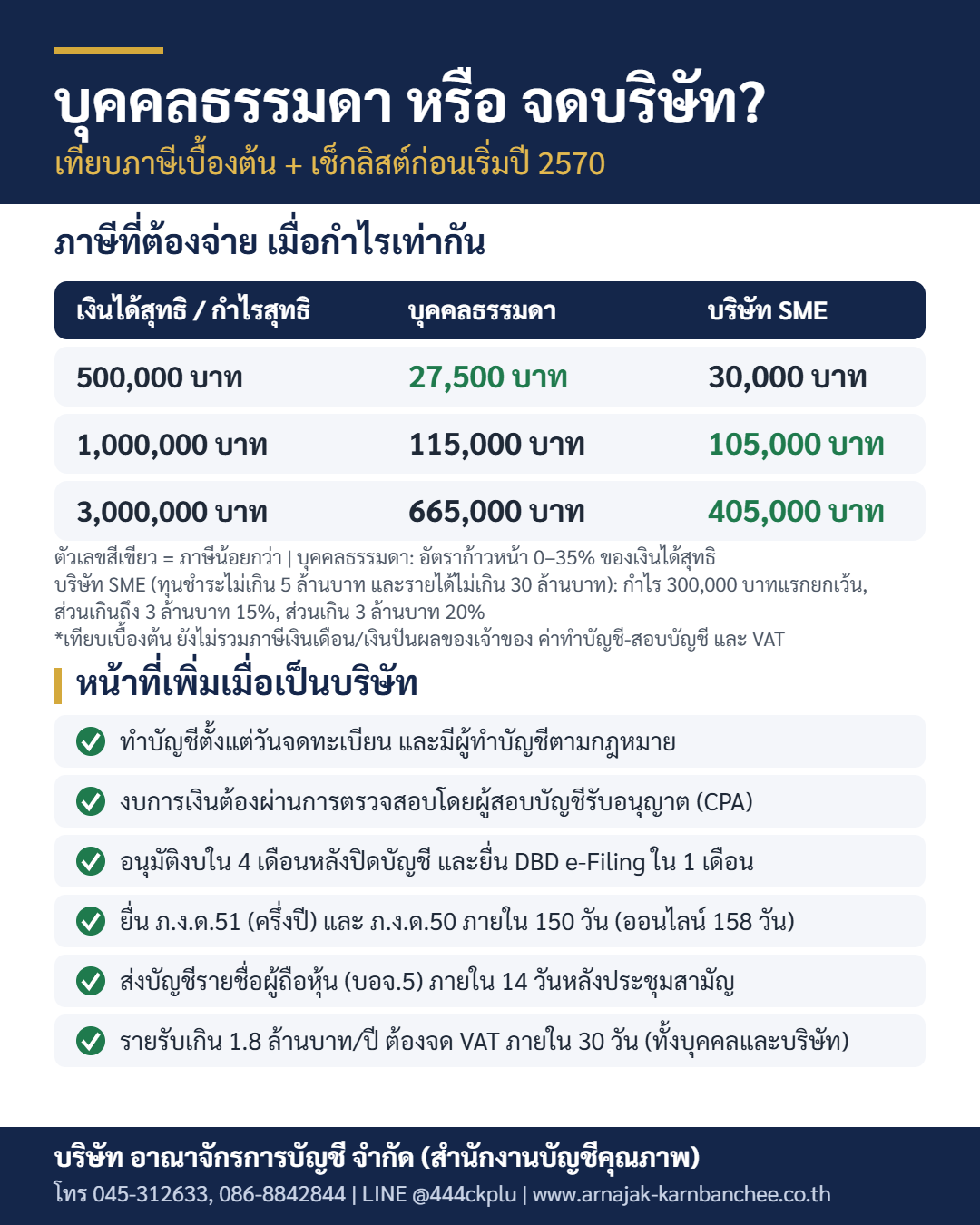
| Net income / net profit | Personal income tax | SME corporate income tax |
|---|---|---|
| THB 500,000 | THB 27,500 | THB 30,000 |
| THB 1,000,000 | THB 115,000 | THB 105,000 |
| THB 3,000,000 | THB 665,000 | THB 405,000 |
Quick calculation: for an SME company with THB 1,000,000 profit, the first THB 300,000 is exempt and the remaining THB 700,000 × 15% = THB 105,000. For an individual with THB 1,000,000 net income, the brackets of 0%, 5%, 10%, 15% and 20% add up to THB 115,000.
So when profit is still modest, an individual may actually pay less tax, while the gap widens as profit grows. This is only a basic comparison. It does not include tax on the salary or dividends the owner takes from the company, bookkeeping and audit fees, or VAT. A real decision should be based on your own business figures.
What changes once you register a company
Being a company comes with recurring duties you should know about first:
- Start bookkeeping from the registration date and appoint a qualified bookkeeper.
- Close the accounts every 12 months and have the financial statements audited by a Certified Public Accountant (CPA).
- Present the financial statements for shareholder approval within 4 months after the closing date, and file them through DBD e-Filing within 1 month after approval.
- File P.N.D. 50 within 150 days after the end of the accounting period (158 days if filed online), plus P.N.D. 51 for the half-year.
- Submit the shareholder list (B.O.J. 5) to the registrar at least once a year, within 14 days after the annual general meeting.
- Keep accounting records and supporting documents for at least 5 years.
Whether you are an individual or a company, if your revenue from selling goods or services exceeds THB 1.8 million a year, you must register for VAT within 30 days from the day revenue exceeds that amount.
Checklist: is your business ready to become a company?
- What is your expected annual net profit, and is it growing?
- Do you have partners or co-investors who need clearly defined ownership?
- Do customers or partners require a juristic-person counterparty, for example for contracts or bidding?
- Do you want to separate personal assets from the business to limit risk?
- Are you ready for the accounting workload of bookkeeping, audits and on-time filings every year?
- Do you plan to apply for loans, open new branches or bring in investors?
If you answer “yes” to several questions, registering a company may be worthwhile, but compare the tax and costs of both options with real numbers first.
How Arnajak Karnbanchee can help
Arnajak Karnbanchee Co., Ltd. is a Quality Accounting Firm certified by the Department of Business Development. We support business owners from the decision stage through to ongoing compliance after registration:
- Tax consulting and planning: compare individual vs. company tax using your actual business figures.
- Financial Modeling & Business Forecasting: project revenue, profit and cash flow for the next 1–3 years.
- Registration with the Department of Business Development and the Revenue Department, such as company incorporation and VAT registration.
- Full-service bookkeeping, financial statement closing and tax filing on time.
- Audits by a Certified Public Accountant (CPA).
- Business valuation and M&A advisory for growing businesses.
We serve businesses, non-profit organizations and individuals, with a flexible scope and fees tailored to each client’s needs.
Talk to us before 2027 begins

Not sure whether to stay an individual or register a company? Contact Arnajak Karnbanchee Co., Ltd. (Quality Accounting Firm) to discuss and plan together.
Tel. 045-312633, 086-8842844 | LINE @444ckplu | Email account@arnajak-group.com | Office hours Mon–Fri 8.00–17.30 | Website www.arnajak-karnbanchee.co.th
Note: The calculations in this article are a basic comparison for illustration. Information as of 27 October 2026 (B.E. 2569).
References
- Revenue Department: Corporate income tax guide for SMEs (Thai)
- Revenue Department: Personal income tax rate table (Thai)
- Revenue Department: Tax guide for individuals doing business (Thai)
- Revenue Department: Who must register for VAT and when (Thai)
- Department of Business Development: Guide for newly registered juristic persons (Thai)
- Department of Business Development: Comparison of limited and public limited companies (Thai)
- Department of Business Development: Registering a memorandum and incorporating a limited company (Thai)
