Preparing for Your FY2026 Audit: CPA or TA, and the Filing Timeline for SMEs

As the year draws to a close, many business owners start hearing phrases like "the auditor is coming to observe the stock count" or "don't forget to book your auditor." Yet many are still unsure which type of auditor their business needs, what documents to prepare, and when the financial statements are due. This article explains it simply for businesses with a year-end of 31 December 2026 (B.E. 2569).

What is an audit and why is it needed?
An audit is when an independent auditor examines a business's records and supporting evidence, then gives an "opinion" on whether the financial statements (reports showing the business's financial position and profit or loss) are fairly presented. Audited statements are filed with the Department of Business Development (DBD) and the Revenue Department, and are more trusted by banks and business partners.
Which auditor does your business need: CPA or TA?
- CPA (Certified Public Accountant) is an auditor licensed under the accounting profession law. Every limited company must use a CPA, regardless of size (a Tax Auditor cannot certify a limited company's statements).
- TA (Tax Auditor) is registered with the Director-General of the Revenue Department and may certify statements only for small registered partnerships with capital not exceeding THB 5 million, total assets not exceeding THB 30 million and total revenue not exceeding THB 30 million (all three conditions must be met).
- A registered partnership that registers its dissolution must use a CPA, whether small or large.
| Example business | Capital / Assets / Revenue | Eligible auditor |
|---|---|---|
| Partnership A | THB 3M / 12M / 25M | TA or CPA (meets all three small-partnership criteria) |
| Partnership B | THB 3M / 12M / 32M | CPA only (revenue exceeds THB 30M) |
| Company C Co., Ltd. | THB 1M / 2M / 5M | CPA only (it is a limited company) |
Timeline for FY2026 (year-end 31 December 2026)
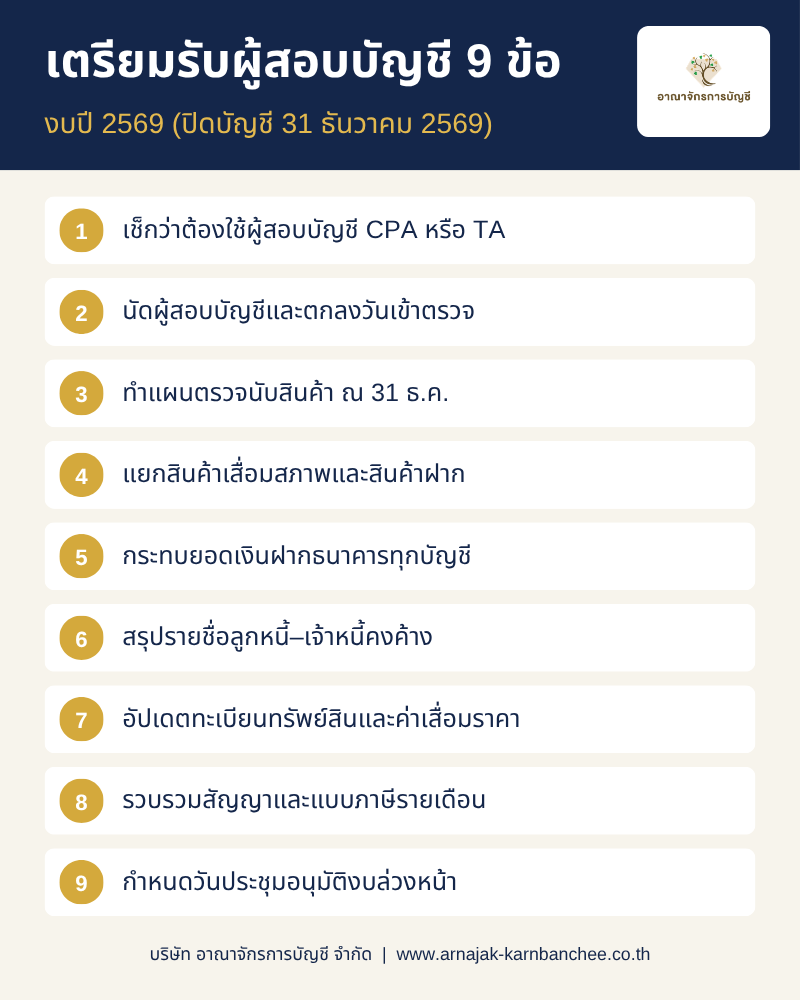
- Now November 2026: Book your auditor and agree on the scope of work and fieldwork dates.
- 31 December 2026 (or close to it): Count your inventory. If inventory is material, the auditor will attend and observe the count.
- January March 2027: The auditor reviews documents, requests confirmations and issues the auditor's report.
- By 30 April 2027: A limited company must present the audited statements to the shareholders' general meeting for approval (within 4 months of the year-end).
- Within 1 month after the approval meeting: A limited company files its financial statements with the DBD. For example, if the meeting is held on 30 April 2027, file by 30 May 2027.
- By 31 May 2027: A registered partnership files its financial statements with the DBD (within 5 months of the year-end).
- By 30 May 2027: File the P.N.D.50 corporate income tax return within 150 days of the last day of the accounting period. For online filing, the Revenue Department has usually granted an extra 8 days; please check that year's announcement.
Preparing for the inventory count
Under Thai Standard on Auditing (TSA) 501, if inventory is material, the auditor must attend the physical inventory count (unless impracticable). The auditor reviews the counting plan, performs test counts and checks that the count results match the business's records. Prepare the following:
- A counting plan: date and time, people responsible, and a map of storage locations.
- Stop receiving and dispatching goods during the count, or clearly separate goods moving in or out that day.
- Pre-numbered count sheets, with copies of every sheet kept.
- Clearly separate damaged, obsolete or third-party goods held on your premises.
- If any inventory is held in someone else's warehouse, tell the auditor in advance, as a confirmation from the custodian may be needed.
Checklist of documents auditors usually request
- Accounting ledgers, trial balance and supporting schedules for each account.
- Year-end statements for every bank account and bank reconciliations.
- Lists of outstanding receivables and payables (the auditor may send confirmation letters directly to banks, customers or suppliers).
- Fixed asset register and depreciation schedule, with documents for assets bought or sold during the year.
- Key contracts such as loan, lease and hire-purchase agreements.
- Monthly tax returns (P.P.30, P.N.D.1, 3, 53) and tax payment receipts.
- Minutes of shareholders' or partners' meetings and the latest company affidavit.
Tips for a faster, smoother audit
- Keep your books up to date every month instead of catching up at year-end.
- Reconcile bank accounts monthly and follow up on unexplained items.
- Organize documents by category, both on paper and digitally.
- Appoint one person to coordinate with the auditor so questions are answered quickly.
- Plan the shareholders' meeting date early, leaving enough time after the auditor's report is issued.
Let Arnajak Accounting take care of your accounting and audit

Not sure which auditor your business needs, or want to get your FY2026 statements ready early? Arnajak Karnbanchee Co., Ltd. (a Quality Accounting Firm certified by the Department of Business Development) offers full-service bookkeeping, financial statement closing, tax filing and audits by CPAs for businesses, non-profit organizations and individuals, with flexible fees tailored to your needs. Talk to us before the year-end closing season.
Tel 045-312633, 086-8842844 | LINE @444ckplu | Email account@arnajak-group.com | Office hours MonFri 8.0017.30 | Website www.arnajak-karnbanchee.co.th
References
- Revenue Department: Q&A on Tax Auditors and small partnerships (Thai)
- Revenue Department: FAQ on P.N.D.50 (Thai)
- Department of Business Development: Guide to filing financial statements and shareholder lists (Thai)
- Federation of Accounting Professions: TSA 501 Audit Evidence (Thai)
- Federation of Accounting Professions: TSA 505 External Confirmations (Thai)