Year-End Closing 2026: An Accounting Checklist for SMEs Before 31 December

In less than three months, 2026 (B.E. 2569) will come to an end. If your business's accounting period ends on 31 December, now is the best time to prepare for "closing the books", because several tasks must be done before or exactly on the last day of the year and cannot be redone afterwards. This article sums up a checklist business owners can follow right away, along with the deadlines for submitting financial statements and filing taxes after the year closes.
What is "closing the books", and why prepare now?
- Accounting period is the 12-month period a business uses to summarise its results. Thai law requires partnerships and companies to close their accounts every 12 months, and most businesses use 1 January to 31 December.
- Closing the books (year-end closing) means making the full year's figures complete and accurate, then preparing financial statements, which act like a "health report" for the business, showing its assets, liabilities and profit or loss.
- Certified Public Accountant (CPA) is a licensed professional who audits financial statements and signs an opinion on them. A limited company's financial statements must be audited by a CPA before they are submitted.
Common problems include missing documents, figures that don't match the bank, or stock that has never been counted. When the auditor arrives early next year, these have to be fixed one by one, which wastes time and risks missing the filing deadline. Preparing now lets you close faster and see a rough profit figure in time for tax planning before year end.

9-point checklist to complete before 31 December
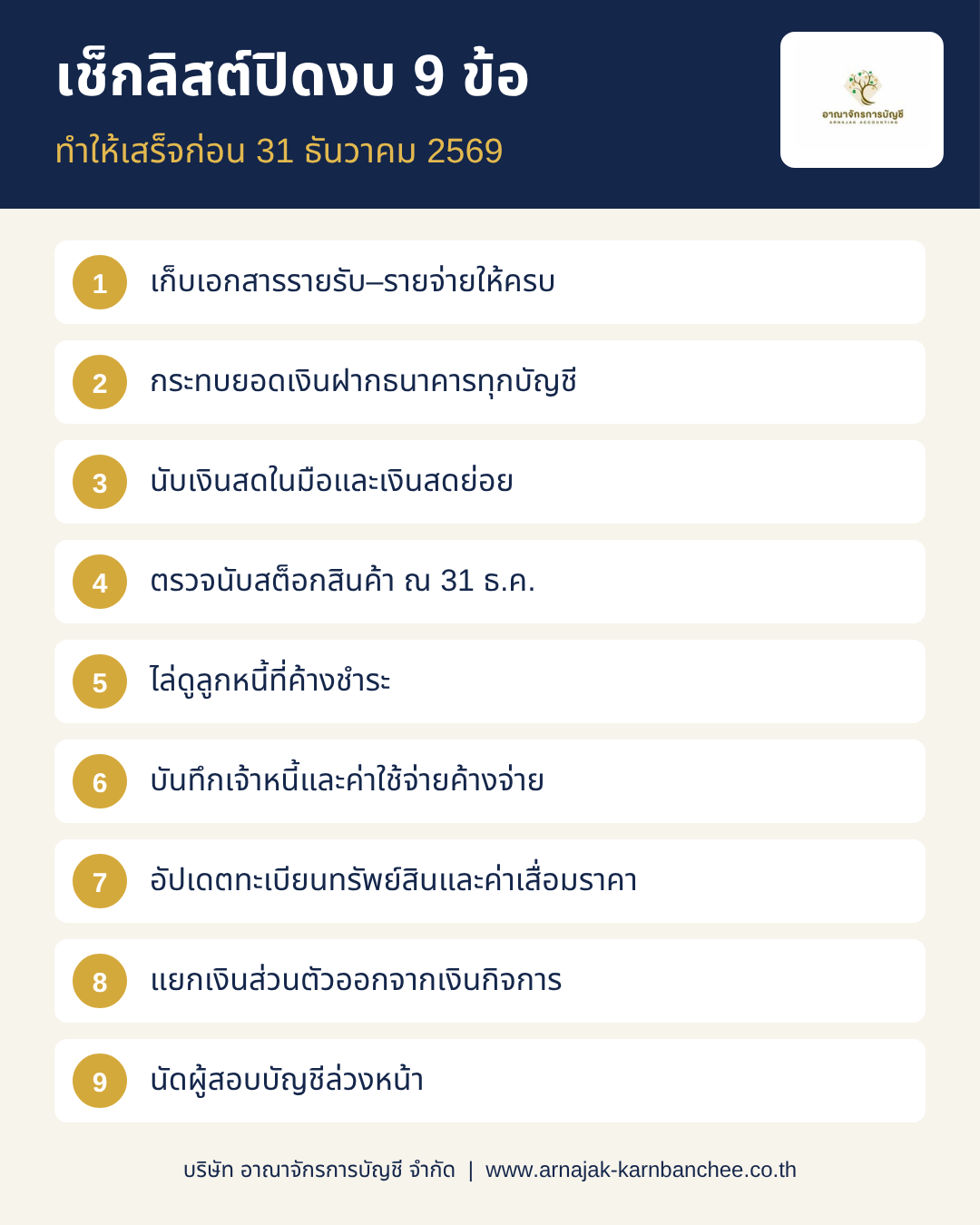
- Collect all income and expense documents tax invoices, receipts, contracts and transfer slips, sorted by month. If any month is missing documents, ask your counterparties for copies now, because expenses without supporting evidence may not be tax-deductible.
- Reconcile your bank accounts "reconciling" means comparing the balance in your books with the bank statement. For example, if your books show THB 120,000 but the statement shows THB 115,000, you need to find out what the THB 5,000 difference is (such as an uncleared cheque or a bank fee you forgot to record). Do this for every account every month, and keep the statement as at 31 December.
- Count cash on hand and petty cash count the actual cash on the last day of the year and compare it with the book balance. Clear any outstanding petty cash vouchers.
- Count inventory (stock) as at 31 December schedule the count date and the people doing it in advance. If your auditor wants to observe the count, agree on the date before year end. Example: your books show 500 units but the physical count finds 480; the missing 20 may be lost, damaged or recorded incorrectly, so find the cause and adjust to the actual figure.
- Review receivables (customers who owe you) prepare an aged receivables report, follow up on long-overdue balances before year end, and keep complete records of your collection efforts.
- Review payables and accrued expenses electricity, rent and wages incurred in December but paid in January are still this year's expenses and must be fully recorded.
- Update your fixed asset register assets used over several years, such as computers and vehicles, are not expensed in full in the year of purchase but spread out as depreciation. Example: a THB 30,000 computer with a 3-year useful life is depreciated at THB 10,000 per year. Check now for any new purchases, disposals, or assets that are broken beyond use.
- Separate personal money from business money clear any transactions where directors used company funds personally, or paid company expenses with personal money, and make sure they are properly documented. Mixed transactions are a leading cause of delayed closing.
- Book your auditor early January to April is auditors' busy season. Agree on the audit schedule and the list of documents to prepare now.
Timeline after closing (businesses closing accounts on 31 December 2026)
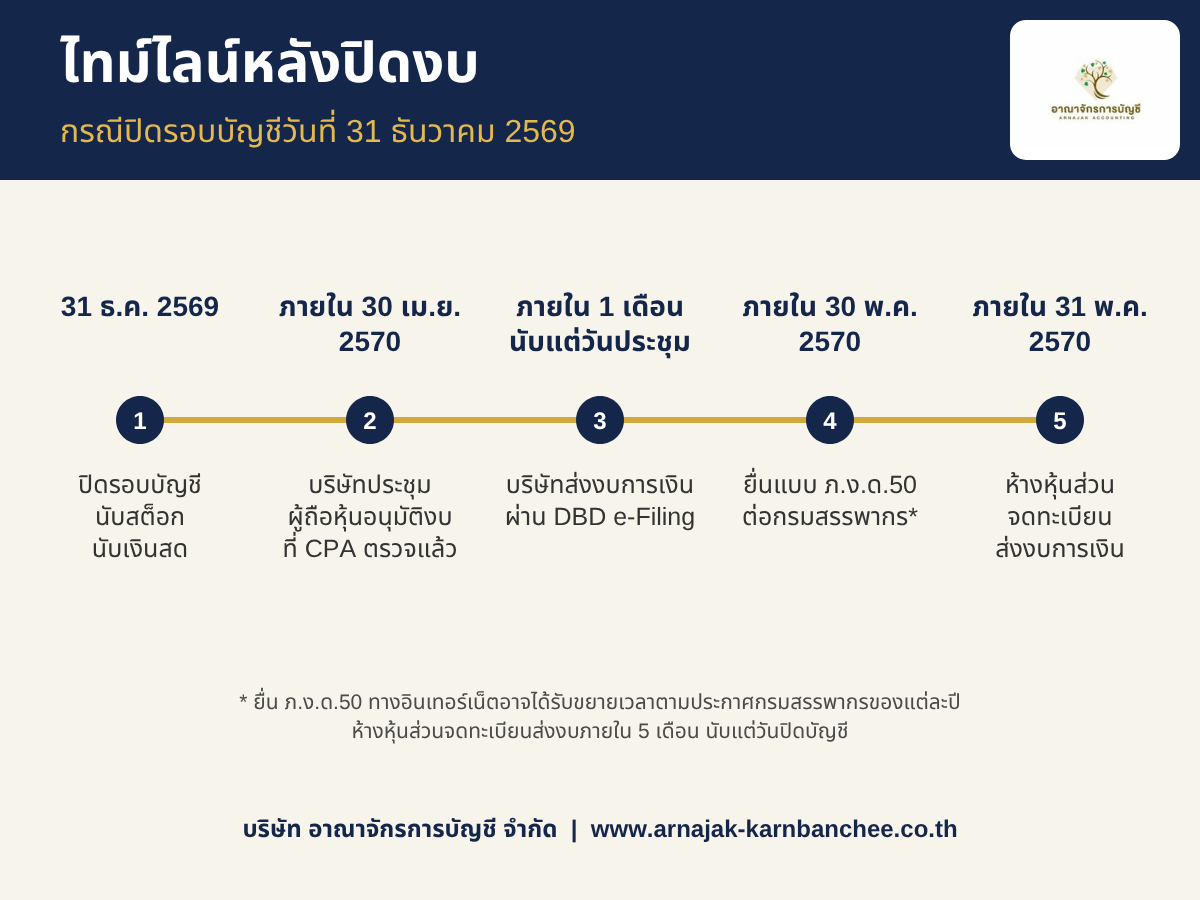
| Task | Who | Legal deadline | Date (accounts closed 31 Dec 2026) |
|---|---|---|---|
| Shareholders' meeting to approve the audited financial statements | Limited companies | Within 4 months of the closing date | By 30 April 2027 |
| Submit financial statements via DBD e-Filing | Limited companies | Within 1 month of the meeting's approval | e.g. meeting on 20 April 2027 submit by 20 May 2027 |
| Submit financial statements via DBD e-Filing | Registered partnerships | Within 5 months of the closing date | By 31 May 2027 |
| File PND.50 (annual corporate income tax return) | Companies and juristic partnerships | Within 150 days of the last day of the accounting period | By 30 May 2027 |
Note: Filing PND.50 online is usually granted an extension under the Revenue Department's announcement each year, so check the latest announcement before filing. Partnerships with capital of no more than THB 5 million, and total assets and total revenue of no more than THB 30 million each, do not need a CPA audit, but still need a tax auditor to examine and certify their accounts for tax filing. Also remember that the law requires accounts and supporting documents to be kept for at least 5 years from the closing date.
In short
Start preparing in OctoberNovember: gather documents and reconcile your accounts, count cash and stock on the last day of the year, and book your auditor in advance. Next year's closing will be faster, your statements will be filed on time, and you won't pay unnecessary fines.
Let Arnajak Accounting handle your year-end closing

Arnajak Accounting Co., Ltd. is certified as a "Quality Accounting Firm" by the Department of Business Development. We help with everything from organising documents and closing the books to coordinating with your Certified Public Accountant and submitting financial statements and tax returns on time. We serve businesses, non-profit organisations and individuals, with flexible fees tailored to each client's needs.
Tel. 045-312633, 086-8842844 | LINE @444ckplu | Email account@arnajak-group.com | Office hours MondayFriday 8.0017.30 | Website www.arnajak-karnbanchee.co.th
References
- Department of Business Development Handbook for newly registered juristic persons (Thai)
- Department of Business Development Handbook on receiving financial statements and shareholder lists (Civil and Commercial Code Section 1197 and Accounting Act B.E. 2543 Section 11) (Thai)
- Revenue Department PND.50 FAQ (Thai)
- Department of Business Development DBD e-Filing system